Author: Nicole

Faculty Profile: Bill Goddard

As an undergraduate at Dartmouth, Bill Goddard enjoyed working at the student radio station—an experience that later helped shape his early professional life, though his career ultimately took him far from broadcasting.

After earning an MBA, he worked on Wall Street as an investment banker during the era that inspired Wall Street’s Gordon Gekko. “It was one heck of a ride in those days!” says Goddard.

He and a classmate later acquired and expanded a small regional radio company, turning around struggling stations before selling the business. The sale gave him the freedom and resources to pursue a long-standing interest in law. “Founding and selling that company gave me the money to go back to school, and the freedom to study what I wanted,” he says.

Goddard chose the University of Connecticut School of Law because it had the nation’s leading insurance law program—and because he wanted to study with Professor Tom Baker. “I really loaded up,” Goddard recalls. “I took Insurance Regulation, Liability, Transactions, Taxation—the curriculum at the Insurance Law Center gave me an enormous toolkit.”

Baker, now at the University of Pennsylvania Carey Law School, immediately recognized Goddard’s promise. “I still remember meeting Bill during his first semester at UConn,” Baker says. “Right after he left my office, I called up Hal Horwich and told him, ‘You have to hire this guy for next summer.’” Horwich, then a partner at Hebb & Gitlin, initially resisted— “We don’t hire 1Ls for our summer program”—but Baker persisted, and Horwich relented. They did, and they didn’t regret it.

“It’s like a bankruptcy on Mars.” — Hal Horwich, as quoted by Bill Goddard

After law school, Goddard clerked on the Second Circuit for Judge Jon Newman— “the most amazing experience intellectually,” he says. “It was like drinking the law from a firehose.” He then returned to Hebb & Gitlin (later Bingham Dana & Gould, and eventually Bingham McCutchen), where he became an expert in insurance, reinsurance, and insurance insolvency. His banking background proved invaluable during major insolvency proceedings, especially during the 2008 financial crisis.

Baker kept an eye on his former student’s career. “And as soon as it was decent, we brought him back to UConn to teach,” Baker recalls. Goddard joined as an adjunct professor in 2008, now marking his eighteenth year in that role.

“I drink my own Kool-Aid,” Goddard says. “Insurance is an elaborate legal structure built around betting on fortuitous events—and who doesn’t like betting on fortuitous events?”

For his first decade teaching at UConn Law, he co-taught Insurance Litigation with John Buchanan and Stuart Rosen (now a Connecticut Superior Court judge). In 2016, he was asked to develop and teach a course on Insurance Solvency Regulation. “When it comes to insurance, I’m always happy to rise to the occasion,” he says. The course quickly became a staple and a student favorite.

“Instead of going bankrupt, insurance companies that fail enter into insolvency proceedings. The process is governed by regulations in individual states rather than the federal bankruptcy code,” explains Goddard. “European lawyers just giggle—our system makes no sense to them. It’s like a bankruptcy on Mars,” he adds, quoting his former mentor Hal Horwich.

In the class, students dissect the structure of the U.S. regulatory system and put themselves in the shoes of regulators or legislators, debating how to address complex, real-world case studies. These “yeasty intellectual questions,” as Goddard calls them, raise constitutional and sovereignty issues that make the subject ideal for deep legal analysis.

Regulators, examiners, and representatives from the Federal Reserve are regular visitors. “So many of the rules and practices of insurance insolvency just aren’t written down,” says Goddard. “Talking directly with regulators gives students that subjective feel and a better overall understanding of the enterprise.”

David Axinn, Special Deputy Superintendent at the New York Liquidation Bureau—and now co-instructor of the Insurance Solvency course—is a frequent classroom collaborator. “Bill makes the case that insolvency is the key to understanding insurance regulation,” Axinn says. “He is a lone voice in the insolvency wilderness.”

Former student Alison Weir, now a staff attorney at Greater Hartford Legal Aid, says, “Insurance solvency sounded pretty dry initially, but it’s so much more dynamic than I had imagined.”

Technological change continues to reshape the insurance world. Goddard had planned to teach a course on insurance technology outside of UConn Law, but when that did not go forward, the Law School then greenlit his new offering, InsurTech Start-up Law, now in its second year.

Goddard hopes more students will explore insurance law’s breadth and impact. “UConn Law and the Insurance Law Center have been wonderful places for people like me,” he says. “Whether it leads you to government service, the insurance industry, or private practice, insurance makes for a fulfilling and rewarding career.”
ACCC Insurance Law Symposium

Friday, November 7th, 2025

University of Connecticut School of Law

39 Elizabeth Street

Hartford, Connecticut

The University of Connecticut School of Law is honored to host the 2025 American College of Coverage Counsel (ACCC) Insurance Law Symposium, the only ACCC event open to non-Fellows. This program brings together leaders in insurance law to discuss emerging issues, share expertise, and foster professional connections.

Alumni of UConn Law enjoy a special discounted registration rate of $225 (regular rate: $300). Faculty and students may attend all or any portion of the symposium at no charge, with advance registration required for planning purposes.

Don’t miss this unique opportunity to join a national conversation in the field of insurance law—right here in Hartford.

MORE DETAILS & REGISTRATION

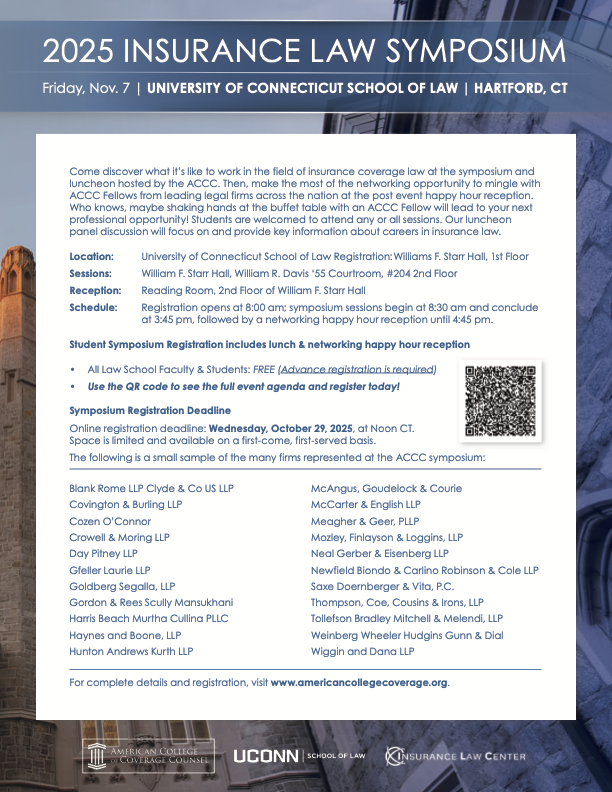
Flyer titled “2025 Insurance Law Symposium” with event date Friday, Nov. 7, at the University of Connecticut School of Law in Hartford, CT. Hosted by the American College of Coverage Counsel (ACCC). Text invites students to explore careers in insurance coverage law, attend sessions, luncheon, and a networking happy hour with ACCC Fellows from national law firms. Details: Location: University of Connecticut School of Law; Registration in Williams F. Starr Hall, 1st Floor. Sessions: William F. Starr Hall, William R. Davis ’55 Courtroom, #204, 2nd Floor. Reception: Reading Room, 2nd Floor of Starr Hall. Schedule: Registration opens 8:00 am; sessions 8:30 am–3:45 pm; networking reception until 4:45 pm. Registration: Free for law school faculty and students with advance registration; includes lunch and reception; QR code for full agenda and registration. Deadline: Wednesday, October 29, 2025, Noon CT; limited space. List of participating firms includes: Blank Rome LLP, Clyde & Co US LLP, Covington & Burling LLP, Cozen O’Connor, Crowell & Moring LLP, Day Pitney LLP, Gfeller Laurie LLP, Goldberg Segalla LLP, Gordon & Rees Scully Mansukhani, Harris Beach Murtha Cullina PLLC, Haynes and Boone LLP, Hunton Andrews Kurth LLP, McAngus Goudelock & Courie, McCarter & English LLP, Meagher & Geer PLLP, Mozley Finlayson & Loggins LLP, Neal Gerber & Eisenberg LLP, Newfield Biondo & Carlino, Robinson & Cole LLP, Saxe Doernberger & Vita P.C., Thompson Coe Cousins & Irons LLP, Tollefson Bradley Mitchell & Melendi LLP, Weinberg Wheeler Hudgins Gunn & Dial, Wiggin and Dana LLP. Footer logos: American College of Coverage Counsel, UConn School of Law, Insurance Law Center.

Fall Insurance Law Center Cocktail Reception

Thursday, September 25
5 – 6:30 p.m.
Hosmer Hall Quad
University of Connecticut School of Law
39 Elizabeth Street
Hartford, Connecticut
In case of inclement weather, the reception will be held in Janet M. Blumberg Hall.

You’re invited to join the Insurance Law Center at the UConn School of Law for a gathering of insurance LLM students, faculty, alumni and insurance professionals. Please register by September 15th.

2025 Cocktail Reception Registration

Register for the Insurance Law Center's Fall Cocktail Reception using the form below:

This field is for validation purposes and should be left unchanged.
Name(Required)
Please list any accommodations you may need for this event for the hosts.

UConn Law, UMN Host Groundbreaking Conference on AI and Insurance

UConn Law and University of Minnesota Successfully Host Groundbreaking Conference on AI and Insurance

HARTFORD, Conn. (May 31, 2025) – The Insurance Law Center at UConn Law, in partnership with the University of Minnesota Law School, successfully hosted a conference on “AI, Insurance Law, and Regulation” on May 30, 2025, at UConn School of Law’s Hartford campus.

The hybrid event brought together more than 200 leading academics, practitioners, regulators, and students to explore critical issues at the intersection of artificial intelligence and insurance law. Attendees participated both in-person and virtually, examining how AI is transforming the insurance industry and its regulatory landscape.

“The intersection of AI and insurance law raises profound questions that will shape the industry for decades. This conference was really exciting and unique. It brought together the field’s leading thinkers for focused, sustained dialogue rather than the fragmented discussions happening elsewhere. The energy in the room was extraordinary. You could feel that we were witnessing a pivotal moment that will influence how America regulates and insures AI risks for years to come,” said Travis Pantin, Director of the Insurance Law Center at UConn Law.

The day-long conference featured four expert panels addressing crucial topics including how insurance can influence AI development and liability frameworks, current and future insurance coverage for AI risks, discrimination and bias concerns in AI-powered insurance systems, and the use of generative AI in insurance coverage drafting and disputes.

Notable speakers included legal scholars from Yale, NYU, University of Pennsylvania, alongside cutting-edge industry leaders, and regulatory experts.

“We are excited to engage with this elite community to tackle the new AI insurance category with the best legal and academic minds in the world,” said George Lewin-Smith of Testudo, a new insurance company developing insurance coverage for AI risks..

The conference also offered a practical lunchtime session on using AI tools in legal practice, providing continuing legal education credits for attorneys.

“This conference has brought together leading voices in AI, insurance, and tort law for an impactful discussion,” said Renee Henson of the University of Missouri School of Law. “With insurance poised to play a central role in AI regulation, the conference arrived at a pivotal moment, one that will no doubt inspire richer, sharper scholarship in this rapidly evolving space.”

Tom Baker of the University of Pennsylvania Carey Law School added, “It was exciting to hear how insurance entrepreneurs are tooling up to face the threats and opportunities that AI will present.”

“The Connecticut Insurance Law Center brought together a coalition of informed, intelligent, and creative thinkers from a variety of perspectives to discuss Artificial Intelligence, the Law, and Insurance. Participating in this critically important discussion was a pleasure and honor,” said Joan Schmit of the University of Wisconsin-Madison.

Philip Dawson of Armilla AI Insurance and Risk Management said, “The conference, which featured leading scholars, legal and industry experts in AI, insurance, and liability, underscored that innovation in AI-specific underwriting and affirmative coverage is accelerating more rapidly than expected.” 

The Insurance Law Center plans to publish selected conference papers in a special symposium issue of the Connecticut Insurance Law Journal, further contributing to scholarship in this rapidly evolving field.

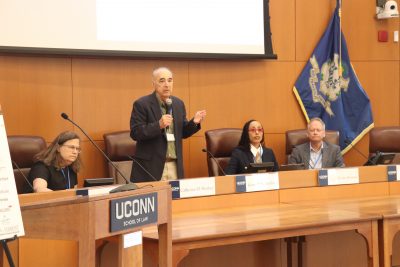
A speaker addresses an audience at a conference panel held at UConn Law. Five other panelists are seated at the long table, with name placards in front of them and the Connecticut state flag in the background.

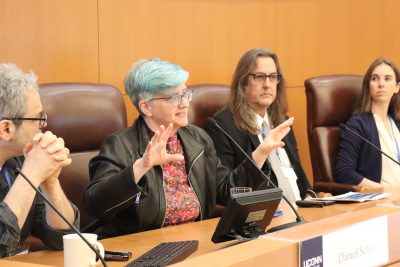
A panelist gestures while speaking during a conference discussion. Other panelists, including a man and a woman in a navy blazer, listen attentively.

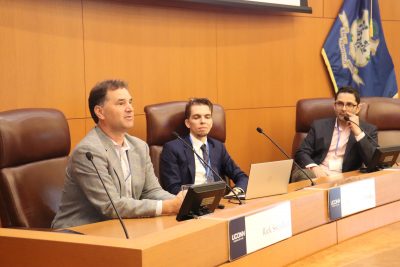
Three panelists, including a man in a gray blazer speaking into a microphone, participate in a discussion. A laptop and microphones are set up in front of them, and the Connecticut state flag is visible behind them.